Content Marketing for SaaS: The Complete Guide to Getting Customers Without Ads
If you're a bootstrapped SaaS founder trying to get your first customers, here's the honest truth: paid ads are expensive, slow to optimize, and brutal on a zero budget. Content marketing for SaaS is the opposite. It compounds over time, costs you mostly time, and attracts the exact people who are already searching for what you built.
The problem? Most SaaS content marketing advice is written for teams with dedicated writers, agencies, and SEO tools that cost $500 per month. This guide isn't that. It's for founders doing it themselves, building their first content engine, and trying to figure out what actually works.

Why Is Content Marketing the Best Customer Acquisition Channel for SaaS Without a Budget?
Content marketing is the best no-budget SaaS acquisition channel because it uses Google as a distribution engine. Once a piece of content ranks, it sends qualified visitors to your site every day without you paying a cent per click. Compare that to paid ads, where traffic stops the moment your budget runs out.
According to Content Marketing Institute research, B2B companies using content marketing generate three times more leads per dollar spent than outbound marketing. For bootstrapped SaaS founders, that asymmetry is everything.
The Compounding Effect: Why It Gets Easier Over Time
Content marketing has a compounding effect that paid ads don't. Your fifth article benefits from the domain authority built by your first four. A blog post you wrote six months ago might start ranking for a new keyword variation today. Each piece of content you publish increases the total surface area of your site and pulls in more organic search traffic over time.
Paid ads work in a straight line. Content marketing curves upward.
Why SaaS Content Works Differently From E-Commerce Content
SaaS buyers research intensely before committing. They compare tools, read reviews, and try to understand whether your product solves their exact problem before they create an account. Content that educates them at every stage of that research process, not just at the bottom of the funnel, is what earns the trial signup.
The goal isn't just traffic. It's trust. A well-written, genuinely useful article tells a potential customer more about your product and your values than any landing page headline ever will.
Content Marketing vs Paid Ads for SaaS: The Real Tradeoff
The tradeoff is time vs money. Content marketing takes three to six months to gain traction. Paid ads can generate leads in 48 hours. But if your budget is limited, waiting three months for free, compounding traffic beats spending $50 per click on ads that stop the moment you pause the campaign.
For bootstrapped founders, the choice is usually clear: start content marketing on day one and build toward sustainable organic acquisition while you manually find your first customers in communities.
How Do You Find What to Write? (The Social Listening Method)
The best way to find content topics for SaaS is to monitor the communities where your potential customers already ask questions. Reddit, LinkedIn, Facebook Groups, and niche Slack communities are full of people asking exactly the questions your product answers. These questions become your article ideas, your headline language, and your keyword map.
This is the social listening method: listen before you write.
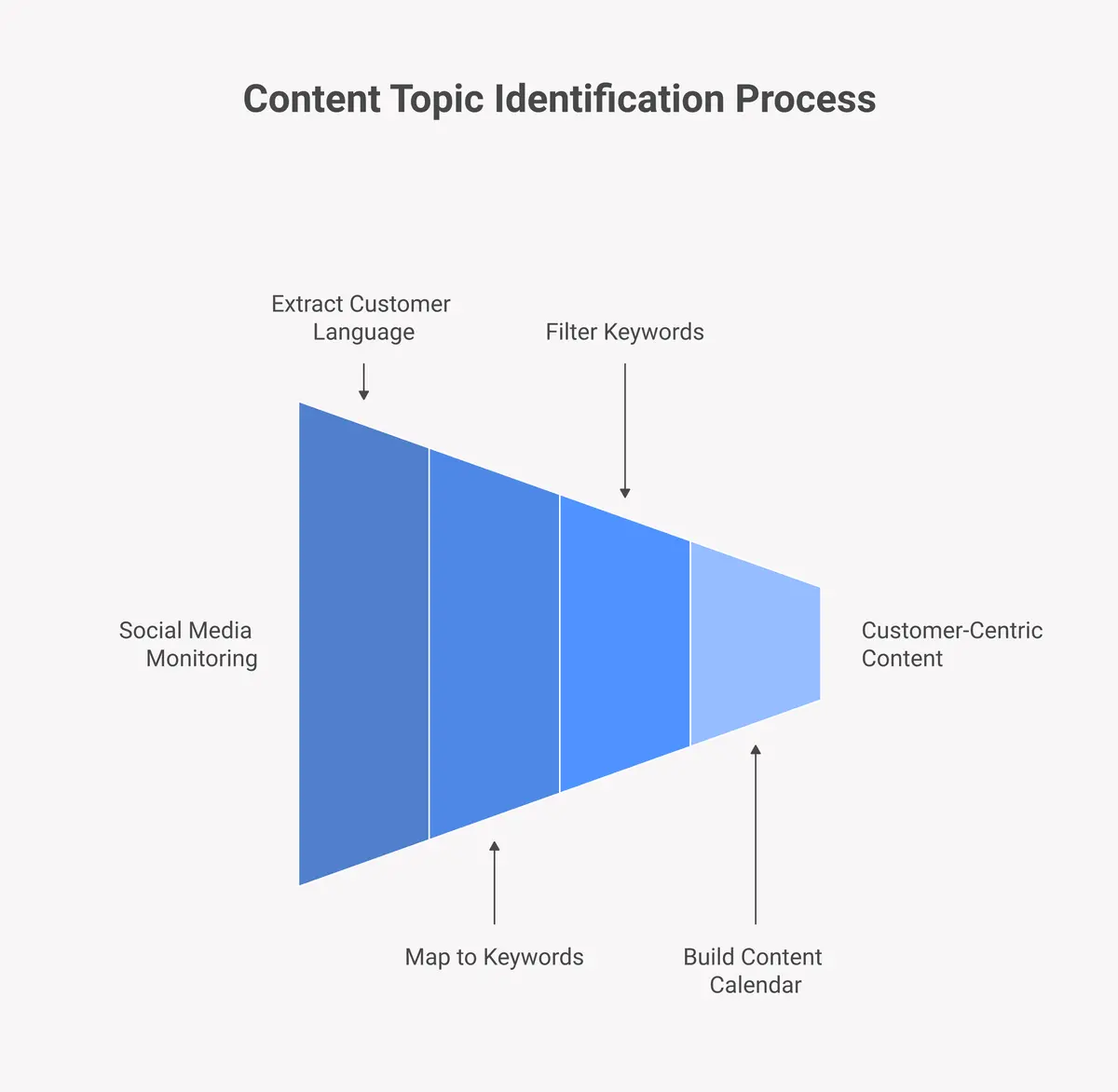
Step 1: Identify Where Your Customers Talk
Start with Reddit. Subreddits like r/SaaS, r/entrepreneur, r/startups, and r/indiehackers are where your target customers share problems, ask for tool recommendations, and complain about products they've tried. These posts are pure research gold. A post asking "what tool do you use for X?" tells you exactly what keywords, pain points, and objections to address in your content.
LinkedIn is equally valuable for B2B SaaS. Posts from founders asking for recommendations, sharing frustrations with their current stack, or debating best practices tell you what the market cares about right now. Not six months ago, not based on an outdated keyword report: right now.
Step 2: Extract the Exact Language Your Customers Use
When you find a post where someone describes their problem, note the exact phrasing they used. "I'm tired of manually checking five platforms for customer mentions" is more valuable than any keyword tool output. It tells you what the searcher is feeling, not just what they typed into Google.
Use social listening for lead generation to monitor these communities systematically without spending hours scrolling. Set up keyword alerts for your niche's pain points and get notified whenever someone posts a buying-intent question.
Step 3: Map Keywords to Content
Take the language you collected and run it through a keyword tool. You're looking for two things: search volume and keyword difficulty. For bootstrapped SaaS, target keywords with fewer than 30 KD (keyword difficulty) first. These are achievable rankings that build authority for harder keywords later.
According to Ahrefs, 90.63% of all web pages get zero organic search traffic because they target keywords that are too competitive. Finding low-KD keywords in your niche isn't a compromise. It's the smarter play.
Step 4: Build a Content Calendar Around Problems, Not Products
Your content calendar should answer the questions your customers ask before they even know your product exists. Don't write about your features. Write about the problems your features solve. "How to find customers on Reddit without getting banned" is a better article than "Hot Lead Alerts Feature Overview."
One practical framework: for every core feature your product has, find three questions a potential customer would ask at the awareness, consideration, and decision stages. Those nine articles are your first content calendar.
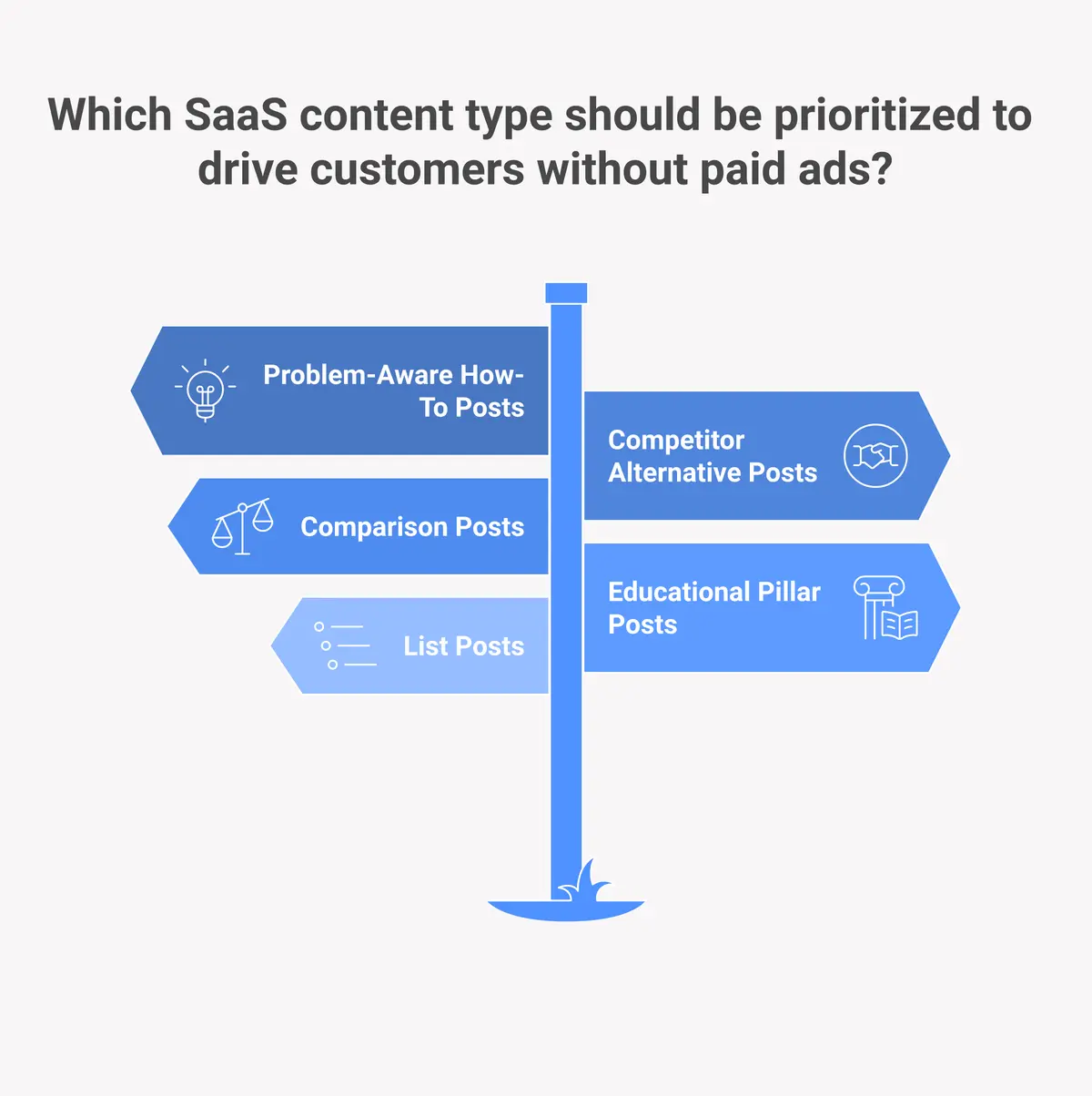
The 5 Content Types That Bring SaaS Customers Without Paid Distribution
Not all content types work equally for SaaS. Some formats drive organic search traffic. Others get shared in communities. A few do both. Here are the five that consistently generate results for bootstrapped SaaS without a paid distribution budget.
1. Problem-Aware How-To Posts
These are articles targeting keywords that start with "how to" and describe the exact problem your product solves. "How to monitor Reddit for mentions" is a problem-aware how-to post. The person searching it is aware they have a problem and actively looking for a method to solve it. They're one step from becoming a customer.
Problem-aware how-to posts rank well because they match search intent perfectly. Write them at the 1,500 to 2,500 word range, include a step-by-step structure, and end with a soft CTA introducing your product as the easier version of the manual process you just described.
2. Competitor Alternative Posts
These target "X alternative" keywords. When someone searches "GummySearch alternative," they're a customer who has already evaluated a competitor and decided it doesn't fit. They're ready to buy. They just haven't found your product yet. A well-written alternative comparison post that honestly acknowledges what the competitor does well, and clearly explains what yours does differently, converts at a much higher rate than a standard feature page.
3. Comparison Posts
Comparison posts target "X vs Y" keywords and work similarly to alternative posts. They capture buyers deep in the evaluation stage. Write them honestly. If a competitor is genuinely better in one area, say so, then explain where your product wins. Readers trust the honesty, and trust converts.
4. Definitional / Educational Pillar Posts
Pillar posts explain core concepts related to your product category: "What is social listening?", "What is Reddit lead generation?", "What is buying intent monitoring?" These rank for informational keywords, build topical authority, and attract links. They take more effort to write but pay dividends for years. A good pillar post in a niche category can generate traffic for three to five years without an update.
5. List Posts Answering "Best X for Y" Queries
People searching "best social listening tools for startups" are actively evaluating tools. A list post that includes your product in a well-curated comparison puts you in front of buyers at the exact moment they're deciding. Include yourself alongside legitimate competitors, be objective about each tool's strengths, and use your entry to naturally highlight the features that make you different.
According to Semrush's State of Content Marketing report, list articles and how-to articles are the two formats that generate the most organic traffic and earn the most backlinks across all industries. For SaaS specifically, these two formats alone can drive the majority of your early blog traffic.
How Do You Distribute SaaS Content Without Paying for Ads?
You don't need a paid distribution budget. The most effective distribution channels for bootstrapped SaaS content are free: organic search, community sharing, and email. The trick is building all three simultaneously from the start.
Organic Search (SEO) as Your Primary Channel
Write every piece of content with a specific keyword in mind. Include the primary keyword in your title, first paragraph, at least one H2, and your meta description. Build internal links between related articles. Submit your sitemap to Google Search Console. These aren't complicated steps, but most early-stage founders skip them and wonder why their content doesn't rank.
SEO is a long game. Expect three to six months before articles begin to rank. The payoff is traffic that compounds, not disappears when a budget runs out.
Community Distribution: Reddit, Indie Hackers, and LinkedIn
Every article you write can be adapted into a post for the communities where your customers hang out. A 2,000-word guide becomes a 400-word post for r/indiehackers or a LinkedIn article that drives readers to the full piece on your blog. But follow the community rules. Don't drop a link and disappear. Participate first. Provide value first. Share your content only when it's genuinely relevant to an existing conversation.
When you monitor those communities with Reddit lead generation alerts, you'll also find the exact conversations where your content is already relevant so you can share it without it feeling promotional.
Email: Your Distribution Moat
Start building an email list from day one. Every person who reads your content and opts in is a distribution channel you own. Unlike social media platforms or search rankings, an email list can't be taken away by an algorithm change. Even a list of 200 engaged subscribers can drive meaningful traffic to new articles and accelerate early ranking signals.
Use a simple inline form at the end of every article. The offer: "Get new guides like this by email, no spam, unsubscribe any time." It doesn't need to be complicated.
Niche Link Building Through Community Participation
Content that answers specific community questions earns links organically. When someone asks a question on Quora, a niche Slack, or a forum, and your article is the best answer, community members link to it. You don't need a formal outreach campaign. You need genuinely useful content and enough community presence to be the person who shares it when it's relevant.
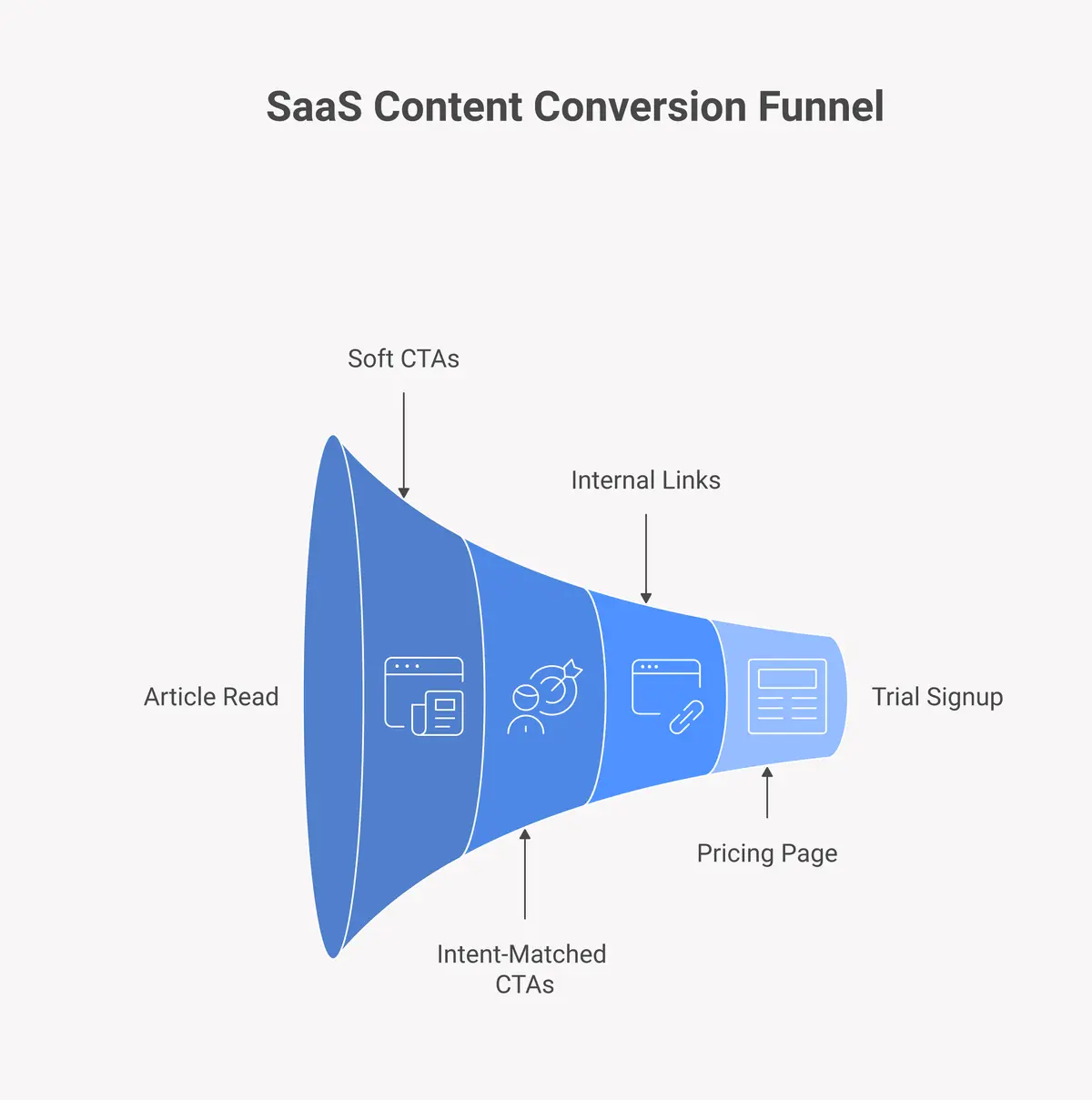
The SaaS Content Conversion Playbook: Turning Readers Into Trials
Traffic is not a business outcome. Trial signups are. The gap between "people reading your blog" and "people paying for your product" is where most SaaS content strategies fall apart. Here's how to close it.
Match Your CTA to the Article's Intent
A problem-aware how-to post should end with a CTA that matches the reader's mindset: "Want the automated version of everything in this guide?" That's a different message than "Start your free trial today," which works better for comparison posts targeting buyers in the decision stage. Match the call to action to where the reader is in their journey, not where you want them to be.
Use Soft CTAs Inside the Body
Don't wait until the end of the article to mention your product. Introduce it naturally where it's relevant inside the body. When describing a manual process that your tool automates, say: "This is what the manual version looks like. If you'd rather have it done for you automatically, try Hot Lead Alerts free for 60 days." The conversion happens before the reader reaches the conclusion.
Build Internal Links That Move Readers Down the Funnel
Your informational posts should link to your service pages and your service pages should link to your pricing. A reader landing on a how-to post about Reddit marketing is one or two clicks away from your pricing page, if you've built the internal link structure correctly. Don't make the reader search for the next step. Show it to them.
Use Mid-Article Offers at the Right Moment
A simple inline offer in the middle of a long article, "Doing this manually takes hours. Here's how to automate it in 3 minutes," with a link to your registration page converts better than a floating pop-up that fires immediately. Give readers value first, then introduce the offer at the moment when the manual process feels most painful to execute.
How Do You Measure SaaS Content Marketing ROI Without Expensive Tools?
You can measure the ROI of your content marketing strategy without a $500/month analytics stack. The core metrics you need are organic search traffic, trial signups from organic, and the pages those signups came from. Google Search Console (free) and Google Analytics 4 (free) give you all three.
The 4 Metrics That Actually Matter
Track these four numbers, and ignore everything else when you're starting out. First: organic clicks per month from Google Search Console. This tells you whether your content is ranking and driving traffic. Second: organic conversion rate, calculated as trial signups from organic traffic divided by total organic sessions. Third: top converting pages, which tells you which articles are actually turning readers into customers. Fourth: keyword rankings for your target keywords, which tells you whether your authority is growing in your niche.
As HubSpot's marketing research consistently shows, companies that measure content performance at the keyword and page level are significantly more likely to report positive ROI from content marketing than companies tracking only overall website traffic.
How Long Before You See ROI?
Realistic expectations: for a new domain, expect three to six months before any significant organic traffic. Your first articles may get very few clicks initially. That's normal. The traffic builds as your domain gains authority and individual articles begin to rank. Most SaaS content strategies start to generate meaningful traffic in months four through seven, then compound rapidly from there.
When to Scale Your Content Marketing Effort
Scale when you see the signal: articles ranking in positions 5 to 20, organic traffic growing month over month, and at least one article converting readers to trial signups at a rate above 1%. At that point, you've validated the channel. Double the content volume, start building links more systematically, and begin targeting medium-difficulty keywords you couldn't rank for when you started.
The social listening strategy that feeds your content calendar doesn't stop once you've found your first topics. It keeps revealing new keyword opportunities and content ideas as your market evolves. The best SaaS content marketers treat community monitoring as a permanent input to their content process, not a one-time research step.
Ready to start finding content ideas from the communities where your customers already are? Try Hot Lead Alerts free and set up keyword alerts across Reddit, LinkedIn, Facebook, Twitter, and Instagram in under three minutes.
Frequently Asked Questions
How long does content marketing take to work for SaaS?
Most SaaS companies see initial organic traction in three to six months. New domains take longer than established ones because Google needs time to evaluate domain authority. The first articles you publish are building the foundation that makes every subsequent piece rank faster. Plan for a six-month runway before expecting content to consistently generate trial signups.
How many articles should a SaaS startup publish per month?
For an early-stage SaaS with limited resources, one to two high-quality articles per month beats four shallow posts. Quality and keyword targeting matter far more than volume in the early stages. Each article should be 1,500 to 2,500 words, target a specific keyword, and genuinely answer the reader's question better than any existing result.
What's the difference between a content marketing strategy and just blogging?
Blogging is writing whatever seems interesting. A SaaS content marketing strategy targets specific keywords at specific stages of the buyer journey, links articles together to build topical authority, and measures which content converts readers to customers. Blogging is an activity. Content marketing is a customer acquisition channel with a measurable ROI.
Do you need a content marketing agency as a bootstrapped SaaS founder?
Not at the beginning. The founder writing their own content has a genuine advantage: authenticity, deep product knowledge, and a point of view that resonates with early adopters. Agencies are useful when you've validated the content channel and want to scale faster. Before that point, doing it yourself is often more effective and always cheaper.
How do you find content topics for SaaS without an expensive keyword tool?
Start with communities. Monitor Reddit, LinkedIn, and niche Slack groups to find the exact questions your potential customers ask. These questions become keyword ideas. Then validate them with free tools: Google Search Console for your existing pages, Google's "People Also Ask" and autocomplete for keyword variations, and Ahrefs' free keyword difficulty checker for competition estimates. This approach, called social listening for content, is also how you find your best-performing article ideas faster than any keyword tool alone.