Social Listening for Lead Generation - What It Is and Why You Should Start Today
Every day, thousands of people post questions like "does anyone know a good tool for X?" or "I'm frustrated with my current Y software, what do you use instead?" on Reddit, Facebook Groups, LinkedIn, Twitter, and Instagram. These are your customers. They're not waiting for a cold email. They're actively asking for a solution right now.
That's what social listening for lead generation is about. It's the practice of monitoring social media platforms for buying-intent posts so you can respond before your competitors do. And once you see how it works, you'll wonder how you ever relied on cold email alone.
What Is Social Listening? (And How It's Different From Brand Monitoring)
Social listening means tracking keywords, phrases, and conversations across social media to understand what people are saying about topics relevant to your business. It goes beyond simple notifications about your own brand name. You're monitoring the broader conversation happening in your market, including posts by people who have never heard of you yet.
Brand monitoring is reactive. You watch for mentions of your own company name so you can respond to reviews or customer service issues. Social listening is proactive. You watch for posts that signal a buying need, a problem you solve, or a frustration with a competitor.
Social Listening vs Brand Monitoring: A Clear Comparison
Brand monitoring answers the question: "What are people saying about us?" Social listening answers: "What are people saying that I should know about?" The second question is dramatically more useful for finding new customers.
Think of it this way. If someone posts "Hot Lead Alerts is great," brand monitoring catches that. But if someone posts "I'm looking for a social listening tool for my sales team," social listening catches that, and that's a live lead.
According to Sprout Social's research on social listening, 68% of consumers feel brands should use social data to understand what customers need. Yet most brands only use social tools to monitor their own mentions. That gap is your opportunity.
Why Most Businesses Use Social Listening Wrong
Most businesses set up alerts for their company name and call it done. They're using a Ferrari to go grocery shopping. The real power of social listening comes from monitoring competitor names, industry pain points, and buying-intent phrases, not just your own brand.
A social media lead generation tool built for sales tracks conversations that signal purchase intent. That's a fundamentally different goal, and it requires a fundamentally different keyword strategy.
Social Listening for Lead Generation: The Core Idea Explained Simply
Social listening for lead generation means setting up keyword monitors on social platforms so you get notified the moment someone posts a buying signal. You respond to that post with a helpful answer that introduces your product. No cold outreach, no spam, no ad spend. Just being in the right place at the right time with the right solution.
The core idea is simple: people post their problems publicly before they hire a solution. Your job is to be the first helpful voice in their inbox when they do.
The Anatomy of a Social Media Lead
Not every post is a lead. The ones that matter share three characteristics. First, the person has an active problem or need right now. Second, they're openly asking for recommendations or solutions. Third, their problem matches something you solve.
Posts that fit this pattern include: "anyone recommend a good X?", "we're switching from Y, what do people use instead?", "frustrated with Z, looking for alternatives", and "our team needs a tool that does X, any suggestions?" These are warm leads, not cold prospects. The person has already raised their hand.
Why Social Leads Are Warmer Than Cold Email
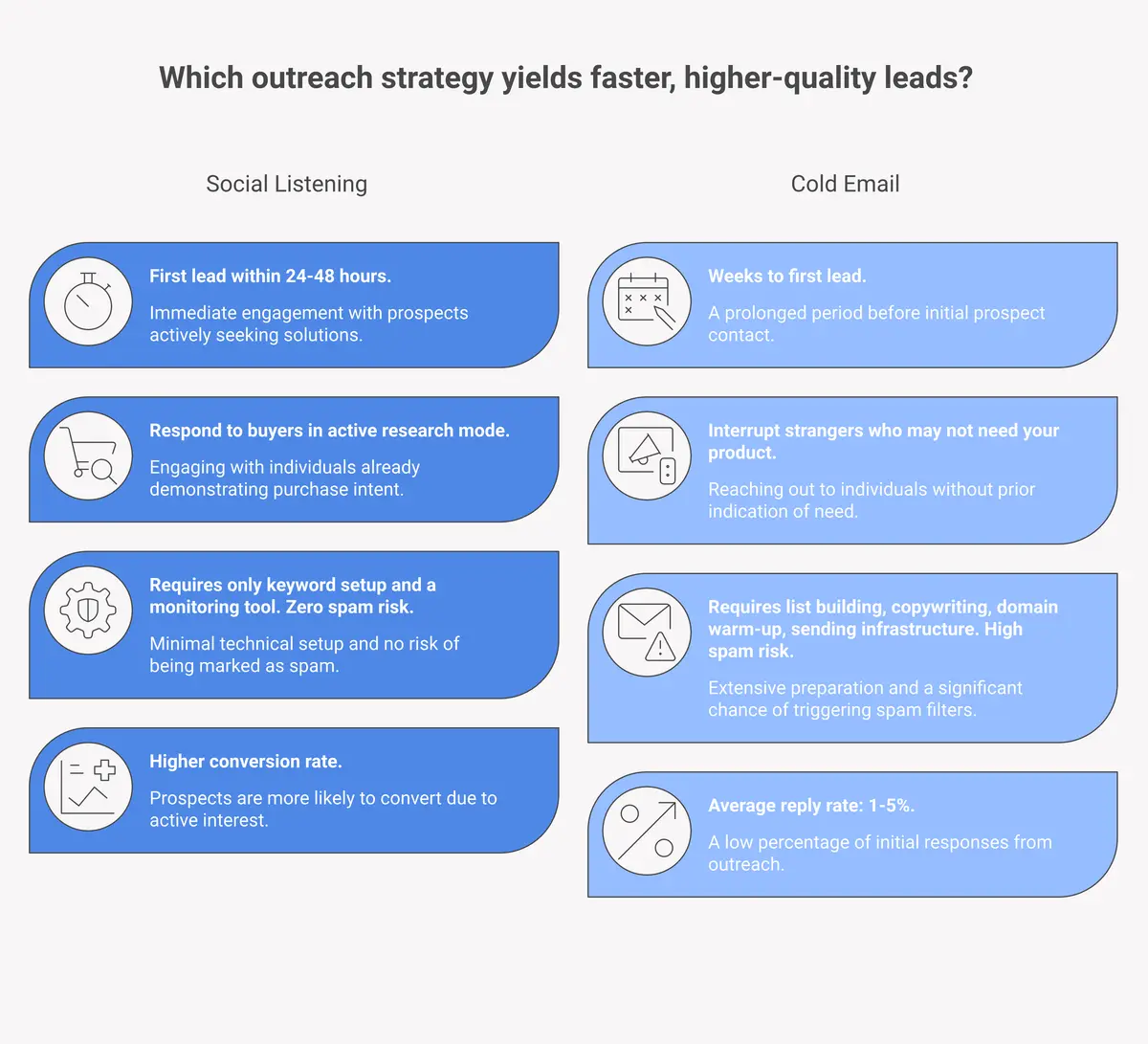
Cold email starts from zero. You interrupt someone who may not need your product, hasn't expressed any interest, and has no reason to trust you. Social listening leads start from the other end. The person already has the problem. They're already in research mode. Your job is just to show up first with a credible, helpful response.
That's why marketing research consistently shows that inbound and referral-style contacts convert at higher rates than outbound cold contacts. Social listening creates an inbound-style dynamic at scale, without the content machine required for SEO or the ad budget required for paid.
The 5 Platforms Where Your Customers Are Talking About Their Problems
Your potential customers are active across five major platforms, each with its own post culture, audience type, and lead quality profile. Monitoring all five gives you the broadest possible coverage of buying-intent conversations.
Reddit: The Best Platform for Raw Buying Intent
Reddit is home to over 100,000 active communities where people ask brutally honest questions about products, tools, and services. The culture rewards helpful answers and punishes spam, which makes it the ideal environment for a credible, product-forward response.
Posts like "what's the best CRM for a 3-person team?" or "anyone using X tool for social listening leads?" appear daily across subreddits like r/entrepreneur, r/SaaS, r/smallbusiness, and hundreds of niche communities. Reddit lead generation is one of the highest-ROI plays available to SaaS founders and consultants today.
Facebook Groups: The Hidden Lead Mine
Facebook Groups host some of the most engaged professional communities on the internet. Industry-specific groups, local business groups, and niche mastermind groups are packed with people asking for product recommendations every single day.
The challenge is coverage. You can't manually join and monitor 50 groups. A social media lead generation tool does it in one stream. Facebook lead generation via group monitoring is particularly strong for local services, B2C products, and SMB-focused SaaS tools.
LinkedIn: Where B2B Buyers Post in Public
LinkedIn is the only major platform where people openly discuss their company's technology stack and buying decisions in public posts. "We're evaluating tools for X," "our team needs a solution for Y," and "any recommendations for Z?" are common post formats from decision-makers and procurement teams.
LinkedIn lead monitoring is uniquely valuable for B2B SaaS because the prospects self-identify their company, role, and budget context in the same post.
Twitter/X: Real-Time Buying Intent
Twitter moves fast, which means buying-intent tweets have a short window before they disappear in the feed. A tweet saying "anyone know a good social listening tool for sales?" gets 20 responses in 2 hours if it gains traction, or zero responses if it doesn't. Being first matters enormously here.
Twitter lead generation alerts catch these high-urgency posts the moment they go live, giving you the first-mover advantage before competitors notice the tweet exists.
Instagram: Underrated for B2C and Local Business Leads
Instagram users ask for product recommendations in comments, Stories, and direct posts more often than most B2B marketers realize. For beauty, fitness, food, local services, coaching, and lifestyle brands, Instagram is a genuinely strong lead source.
Instagram lead monitoring tracks keyword-matched posts and comments so you catch buyers in discovery mode, not just fans of existing brands.
Social Listening vs Cold Email: Which Gets Better Leads?
The honest answer is that social listening produces warmer leads with less friction, but cold email still reaches people who never post publicly. The two approaches serve different moments in the sales process. Social listening finds people who are actively asking. Cold email reaches people who haven't spoken up yet.
That said, the lead quality comparison strongly favors social listening for the right use cases.
Why Cold Email Response Rates Are Declining
Cold email open rates and reply rates have been declining steadily as inboxes get more crowded and spam filters get smarter. Cold email benchmark data shows average cold outreach reply rates hover between 1-5% for most industries. That means 95 out of every 100 emails you send generate no reply at all.
Social listening leads, by contrast, start with someone who already has the problem and is already in solution-finding mode. Your response rate on a well-timed, genuinely helpful social media reply will be orders of magnitude higher than a cold email to a list.
When Social Listening Wins
Social listening dominates when your target customers actively discuss their problems in public. SaaS founders, small business owners, consultants, agencies, coaches, and freelancers all talk openly on Reddit, LinkedIn, and Twitter. If your ICP matches any of those profiles, social listening will outperform cold email for lead quality.
It also wins on cost. A cold email campaign requires list building, copywriting, domain warm-up, and sending infrastructure. A social listening setup requires keyword configuration and a tool. The time-to-first-lead is dramatically shorter.
When Cold Email Still Makes Sense
Cold email makes sense when your prospects don't post publicly, which is often true in very large enterprise deals where decision-makers stay off social media. It also works for highly specific, narrow lists where you know the exact company and contact. In those cases, use both approaches in parallel.
How to Set Up Social Listening for Lead Generation in 10 Minutes
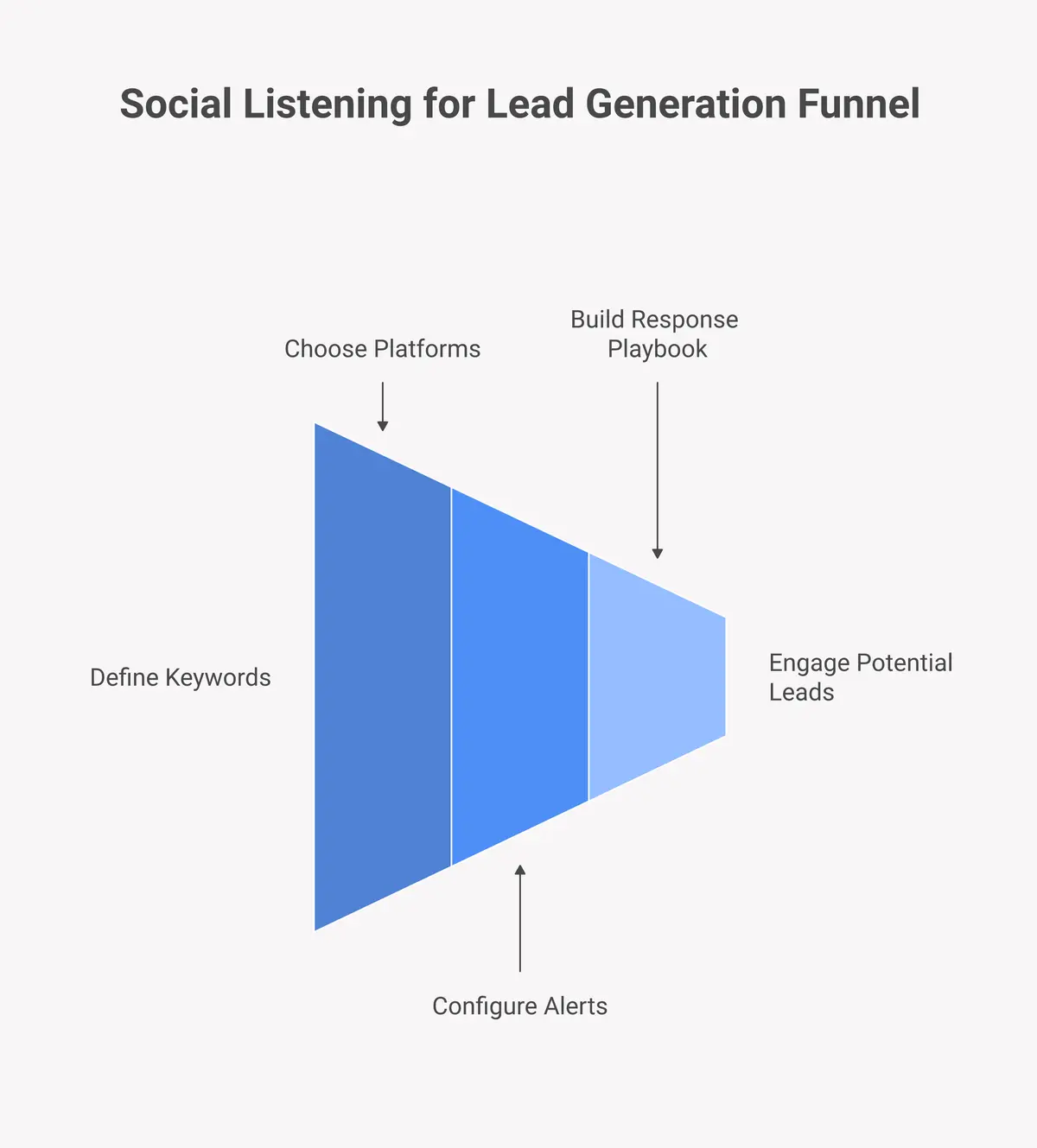
Getting started with social listening for lead generation does not require a technical setup. The hardest part is choosing the right keywords. Here is the exact process to go from zero to live alerts in under 10 minutes.
Step 1: Define Your Buying-Intent Keyword List
Start with keywords that signal active need. Think about the phrases someone would type when they're looking for a solution like yours. Start with three categories: problem keywords ("frustrated with X", "struggling with Y"), comparison keywords ("X vs Y", "alternatives to Z"), and recommendation keywords ("best tool for X", "anyone recommend Y").
Write down 10-15 of these phrases. You'll refine them over the first week based on which ones trigger relevant posts.
Step 2: Choose Your Platforms
Pick the platforms where your customers are most active. B2B SaaS: prioritize Reddit and LinkedIn. B2C products: prioritize Instagram and Facebook Groups. Services and consulting: Reddit and LinkedIn together. Twitter works as a high-velocity supplement for any category.
Start with 2-3 platforms rather than all 5. You want to respond well to a manageable stream of leads before scaling coverage.
Step 3: Configure Your Alerts
Set up your keyword monitors in Hot Lead Alerts. Enter each keyword phrase, select the platforms, and choose your notification frequency. Real-time alerts work best for Twitter and Reddit where timing matters most. Daily digest works for Facebook Groups and LinkedIn where posts have a longer engagement window.
The whole configuration takes under 10 minutes. Start your free trial and you'll have your first alerts running before the end of a coffee break.
Step 4: Build Your Response Playbook
Write 5-10 templated responses you can customize quickly. Each template should lead with genuine helpfulness before mentioning your product. Aim for a 70% helpful / 30% promotional ratio in your replies. The most effective social listening leads convert because the responder sounds like a knowledgeable peer, not a salesperson.
What Keywords to Monitor (Buying-Intent Keyword Framework)
The keywords you monitor determine the quality of your lead stream. Monitor the wrong terms and you'll get noise. Monitor the right terms and you'll see a steady flow of warm prospects. Here is a framework that works across industries.
Category 1: Recommendation Requests
These are the highest-value posts. Someone is actively asking for a product recommendation right now. Keywords to monitor: "recommend a ", "best for ", "looking for ", "anyone use ", "what do you use for ".
Customize the bracketed terms for your category. A project management tool would monitor "best project management tool for remote teams." A social listening platform would monitor "best social listening tool for sales."
Category 2: Frustration and Switching Signals
These posts signal someone ready to switch. They're unhappy with their current solution and looking for alternatives. Keywords: "frustrated with ", "leaving ", "switching from ", " alternative", "tired of ", " is too expensive."
This category requires knowing your top 3-5 competitors by name. Monitor each competitor name combined with words like "alternative," "switching," "vs," and "too expensive."
Category 3: Pain Point Keywords
These posts describe the problem without mentioning specific tools yet. The person is still defining their problem. Keywords: "struggling with ", "how do you manage ", "does anyone else have issues with ", "we need a better way to ."
Pain point keywords have lower purchase intent than recommendation requests, but higher volume. They're great for top-of-funnel awareness and positioning yourself as the expert before the person starts comparing tools. These posts also function as sales triggers social media teams can act on immediately, because they tell you exactly when someone enters the problem-awareness phase of the buying journey.
Category 4: Competitor Comparison Searches
When someone posts " vs " or "comparing X and Y," they're deep in the buying process. Monitor your category name plus the word "vs" and "comparison." Also monitor " vs " to catch people who already know you but haven't decided yet.
Social Listening Lead Generation: Real Examples by Industry
The best way to understand how social listening for lead generation works in practice is to see real use-case examples. Here are how businesses in different categories use it.
SaaS and Software Tools
A project management SaaS monitors Reddit's r/projectmanagement for posts like "our team is outgrowing Trello, what do people move to?" The response: a short, helpful message explaining how their tool handles the specific pain point mentioned. No pitch, just context. The poster books a demo because the response was the most relevant one in the thread.
A social listening tool for sales teams monitors LinkedIn for posts from sales managers saying "our current tool doesn't track social mentions, anyone solve this?" One personalized reply, one discovery call, one deal. The cost of acquiring that lead: 10 minutes of monitoring and 5 minutes of writing a reply.
Consulting and Agencies
A marketing agency monitors Facebook Groups for local business owners asking "does anyone know a good SEO agency in ?" They respond with a helpful post about what to look for in an SEO agency, link to a case study, and offer a free audit. Three responses per week generate one new client per month at zero ad spend.
A freelance copywriter monitors LinkedIn for posts from founders saying "I'm looking for someone who can write SaaS landing pages, any recommendations?" The post is a hot lead. A well-crafted reply with a portfolio link converts at 20-30% because the prospect is already in buying mode.
Local Service Businesses
A plumber monitors Facebook Groups for local homeowners posting "anyone recommend a reliable plumber in ?" A quick response with a professional profile and review link puts them at the top of the recommendations. No Yelp ad, no Google ad, just being in the right community at the right moment.
A fitness coach monitors Instagram for local users posting "anyone know a good personal trainer near ?" with a location tag. The response is a direct message introducing themselves. This works consistently for personal trainers, nutritionists, physical therapists, and other local service providers.
Recruiters and Talent Agencies
A tech recruiter monitors LinkedIn for posts saying "our startup is hiring a senior engineer, any recommendations for sourcing?" They respond with a brief intro to their specialized tech recruiting service. This surfaces inbound warm leads without any outbound effort beyond monitoring the keyword stream.
Social Listening Lead Generation Case Studies
Real-world results help calibrate expectations. Here is how different types of businesses have used social listening to find customers consistently.
Case Study 1: SaaS Founder, Zero-to-Customer in 48 Hours
A founder launching a customer feedback tool set up monitoring for "looking for feedback tools," "Google Forms alternative," and "Typeform too expensive" across Reddit and Twitter. Within 48 hours they had 12 relevant posts to respond to. They replied to 8 of them with a detailed, helpful answer. Three people signed up for the free trial. One became a paying customer within the first week.
Total time invested: 2 hours of keyword setup, 4 hours of responses. Cost: the price of the monitoring tool. Revenue generated: first paying customer from an entirely cold start.
Case Study 2: Agency, $40K Client From a Facebook Group Post
A content marketing agency monitored a Facebook Group for B2B founders. They caught a post from a Series A CEO saying "we need content marketing help but don't want to hire in-house, any agencies people actually recommend?" The agency's team lead responded with a short case study relevant to the CEO's industry and offered a strategy call.
The call happened two days later. The engagement was signed within a week. Value of the client: $40,000 in first-year retainer fees. Total cost of the lead: one Facebook Group membership and a monitoring keyword.
Case Study 3: Consultant, Consistent Lead Flow via LinkedIn Monitoring
A revenue operations consultant set up LinkedIn monitoring for "we need a RevOps consultant," "VP of Sales looking for," and "our sales process needs fixing." They saw 3-5 relevant posts per week and responded to each with a short, specific insight about the problem described.
Over three months, this generated 14 discovery calls from inbound interest, 6 proposals, and 4 closed deals. The win rate was higher than cold outreach because every call started from a known pain point the prospect had already articulated publicly.
The takeaway: you don't need to monitor mentions for leads at massive scale to get ROI. Even 3-5 genuinely relevant posts per week, handled well, generate consistent pipeline for a solo consultant or small team.
If you want to use social listening to find customers in your niche, the cases above show the formula. Choose buying-intent keywords, monitor the right platforms, respond with genuine helpfulness, and let the tool do the heavy lifting in between. Hot Lead Alerts was built specifically for this workflow.
Ready to see your own results? Create your free Hot Lead Alerts account and start catching buying-intent posts across all 5 platforms today. Your next customer is posting right now. The only question is whether you're watching.
Frequently Asked Questions
Is social listening the same as brand monitoring?
No, they serve different goals. Brand monitoring tracks mentions of your own company name so you can respond to feedback and customer service issues. Social listening is broader: you monitor keywords related to your market, your competitors, and the problems your product solves. Social listening finds new customers who have never heard of you yet. Brand monitoring manages relationships with people who already know you.
How much does social listening cost?
Enterprise social listening platforms like Brandwatch and Sprinklr start at $1,000+ per month. Mid-range tools like Mention and Brand24 run $50-$300 per month. Hot Lead Alerts is priced for founders, freelancers, and small teams who need the lead generation functionality without the enterprise price tag. See current pricing here. Most teams see positive ROI within the first week if they respond to alerts consistently.
Can social listening replace cold email?
For many businesses, yes. If your customers actively post about their problems on Reddit, LinkedIn, Facebook Groups, Twitter, or Instagram, social listening delivers warmer leads with higher conversion rates than cold email at a fraction of the cost. That said, cold email still makes sense for highly targeted outreach to prospects who don't post publicly. The best approach combines both: use social listening as your primary inbound lead source and cold email for accounts you specifically want to reach.
How quickly can I get my first lead using social listening?
Most users see their first relevant post within 24-48 hours of setting up monitoring, depending on their keyword choices and industry. High-volume categories like SaaS tools, marketing services, and local businesses typically see several relevant posts per day. Niche B2B categories may see 2-5 per week. The key is starting with well-chosen buying-intent keywords rather than broad topic terms.
Which platform has the best leads for social listening?
It depends on your audience. Reddit has the highest density of raw buying-intent posts across tech, SaaS, and entrepreneurship categories. LinkedIn is best for B2B decision-makers in enterprise and mid-market companies. Facebook Groups work best for local services and consumer-facing products. Twitter is best for high-velocity, time-sensitive buying signals. Instagram is strongest for B2C, beauty, fitness, food, and local services. Most businesses benefit from monitoring at least 2-3 platforms simultaneously.