How to Get Your First 10 Customers: The Honest Guide for SaaS Founders
Here's something nobody tells you when you launch a SaaS: getting your first 10 customers is harder than getting the next 100. Not because the product isn't good enough. Because the problem is structural. You're asking people to trust a tool with no reviews, no case studies, no logos on a homepage, and no evidence that anyone else has taken the risk before them.
The tactics that work for acquiring customers number 50 through 500 don't work for customers 1 through 10. The audience doesn't exist yet. The trust signals aren't there. This guide is specifically about that gap.

Why Getting the First 10 Customers Is Harder Than the Next 100
The first 10 customers are hardest to get because every standard acquisition channel depends on social proof, audience, or budget you don't have yet. SEO takes months to rank. Paid ads need conversion data to optimize. Referrals require existing customers to refer people. Product Hunt rewards existing audiences. Content marketing needs domain authority. Every channel has a bootstrapping problem.
Your first 10 customers come from you, not from channels. From conversations you start, posts you respond to, communities you participate in, and people you reach out to directly. There's no shortcut around that.
The Trust Gap Problem
When someone discovers your product cold, they ask: "Is this real? Has anyone used it? Will it still be around in 6 months?" Without reviews, testimonials, or visible traction, every one of those questions gets a "maybe not" answer. Your job with those first 10 customers isn't just acquisition. It's building enough trust to overcome the evidence gap.
Why Founders Get Stuck at Zero
The most common failure pattern is founders waiting for inbound traffic while working on the product. They assume shipping good software is the hard part, and that customers will discover it once it's good enough. But discovery doesn't happen automatically. "Build it and they will come" is a myth that costs founders months of wasted time.
The founders who get their first customers fastest are the ones who go where customers already are, rather than waiting for customers to find them.
What Doesn't Work: Ads, Directories, and "Build It and They Will Come"
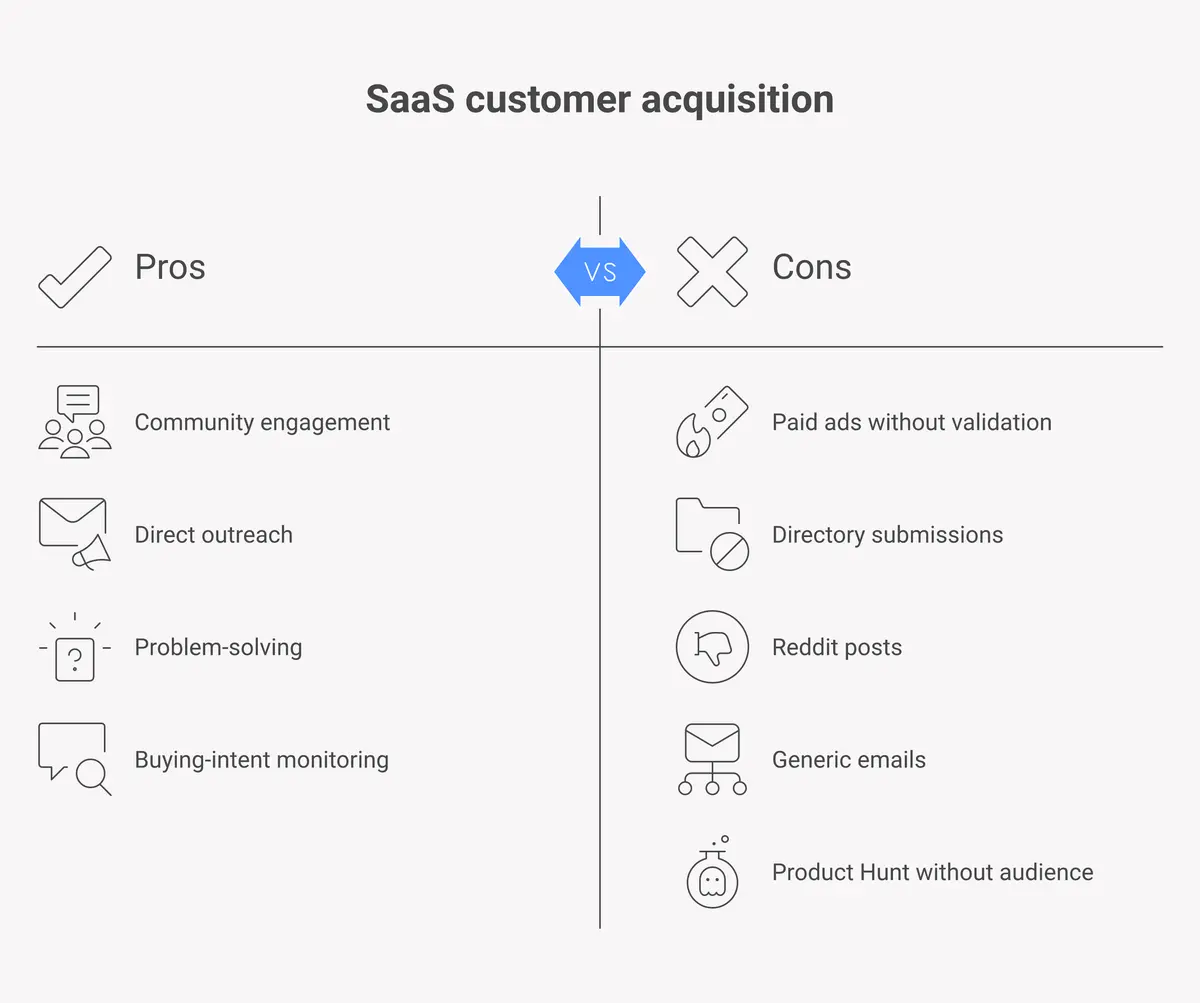
Before covering what works, it's worth being direct about what doesn't work for getting your first 10 SaaS customers, because most founders try these tactics first and wonder why nothing is happening.
Running Paid Ads Before You Have Conversion Data
Paid ads require you to know what converts. You need a landing page that resonates, a value prop that's proven to work, and enough traffic data to optimize toward conversions. With fewer than 10 customers, you don't know any of that yet. Ads at this stage are expensive experiments that rarely produce paying users and always drain budget you don't have.
Submitting to Directories and Waiting
Product directories like Product Hunt, BetaList, and Capterra are not customer acquisition channels for zero-audience founders. They're distribution amplifiers for founders who already have an engaged audience to mobilize. Without an existing following, your launch generates noise for one day and then nothing. Directories work as an accelerant, not an ignition source.
Posting About Your Product on Reddit
Posting promotional content about your product in subreddits results in one of two outcomes: it gets removed by moderators, or it gets ignored. Reddit's communities are allergic to self-promotion. The founders who successfully use Reddit for customer acquisition never post about their product. They respond to threads where people describe the exact problem they solve. That's a different strategy entirely.
Generic Cold Email Blasts
Mass cold email with generic templates generates response rates under 1% and burns your domain reputation. The cold outreach that works is hyper-personalized, short, and directly references something specific about the recipient's situation. That's not a scalable channel yet. It's a manual craft at this stage.
Method 1: The "Listen First" Approach to Finding Your First 10 Customers
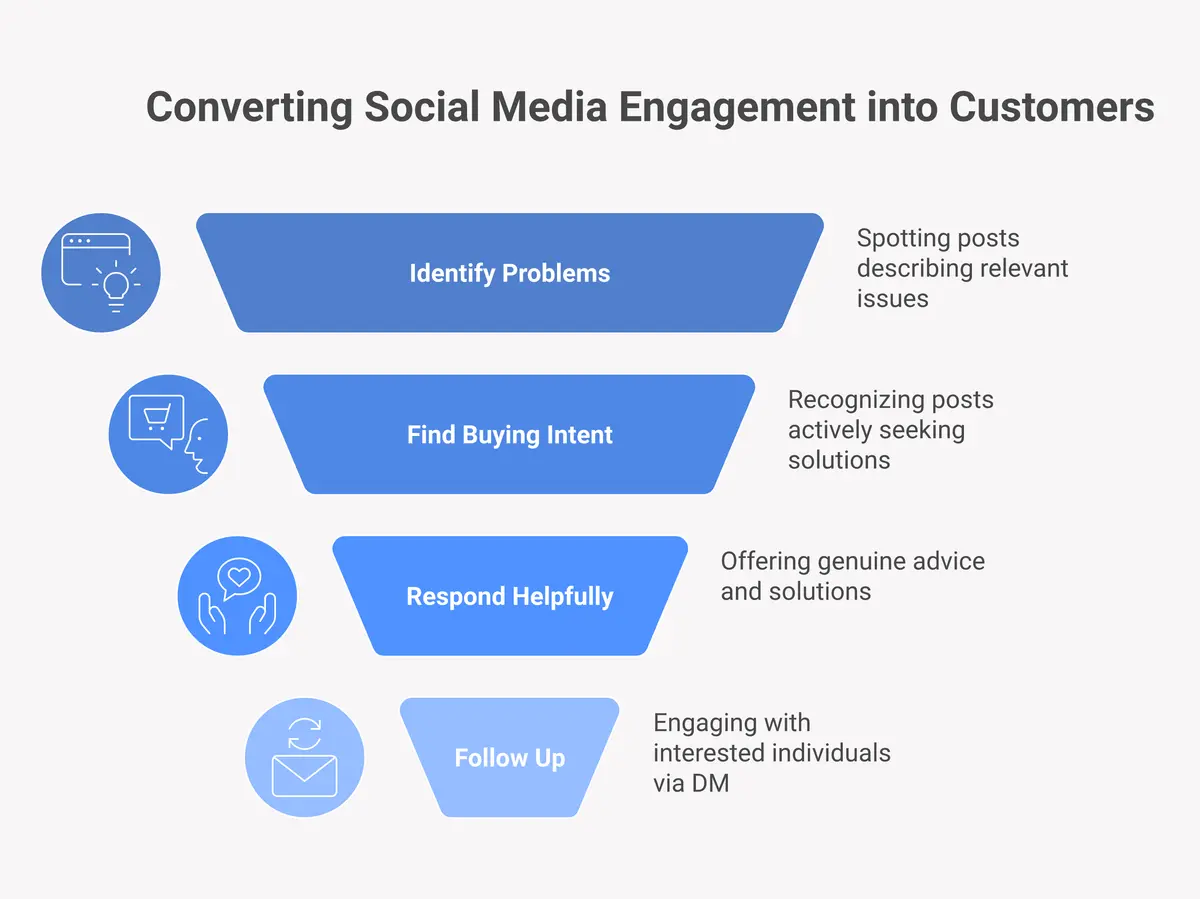
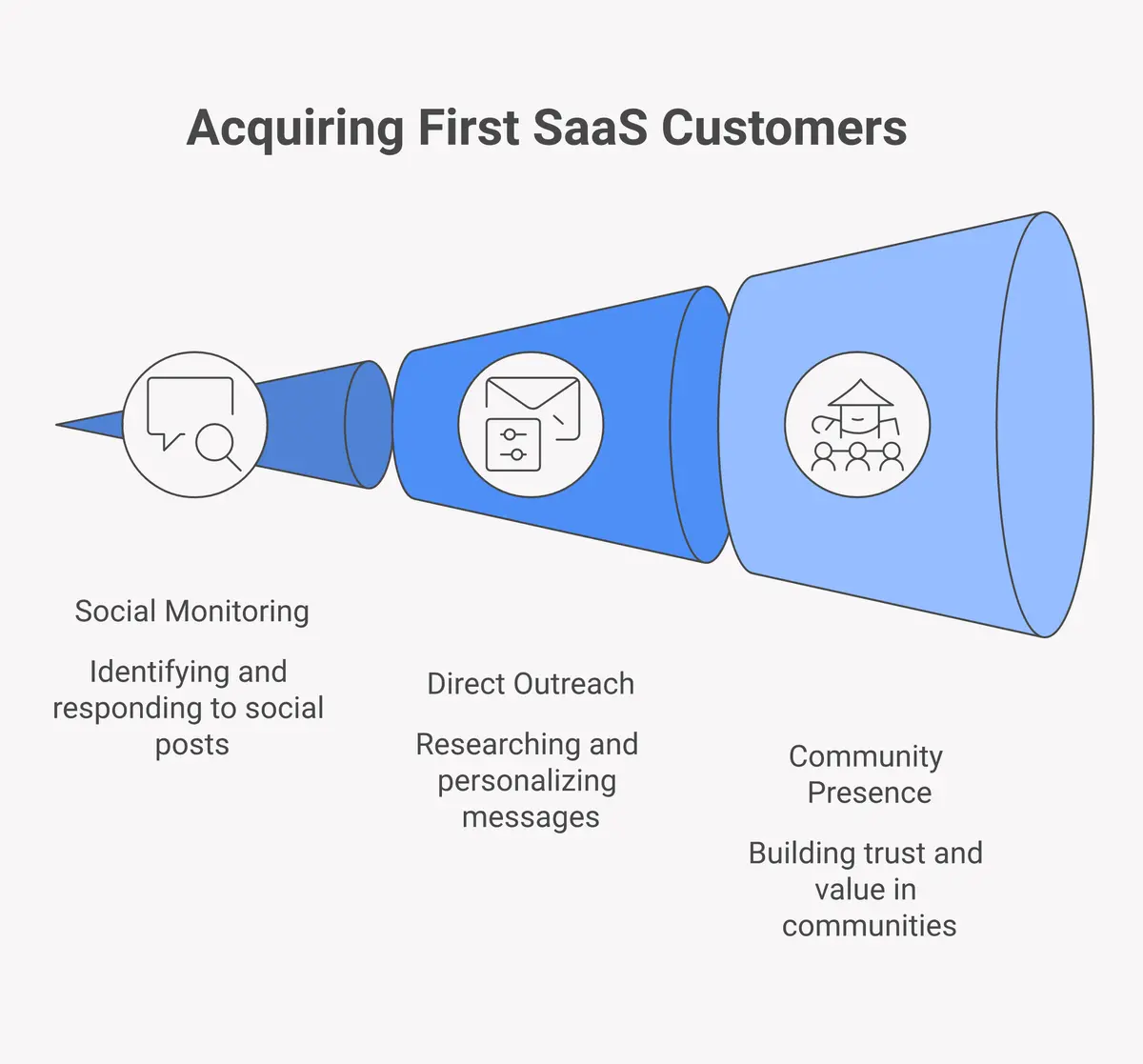
The Listen First approach is the most effective method for getting your first 10 customers because it finds buyers who are already looking for your solution, rather than trying to convince people who aren't. Here's how it works.
Step 1: Monitor Communities for Buying-Intent Posts
Every day, thousands of posts go up across Reddit, LinkedIn, Facebook Groups, and Twitter where people describe the exact problem your product solves. "What's the best tool for tracking brand mentions?" "Does anyone know how to monitor Reddit for customer feedback?" "I'm looking for a way to find leads on social media without spending hours scrolling."
These posts are your first customers raising their hand. Use social listening for lead generation to monitor these communities with keyword alerts. Instead of manually checking 20 subreddits and LinkedIn feeds every day, set up alerts for your key problem keywords and get notified when a relevant post appears.
Step 2: Identify Which Posts Signal Buying Intent
Not every post is a lead. Buying-intent posts have specific characteristics: they describe a current pain point, they ask for a recommendation or solution, or they compare tools they're considering. Posts that say "I'm using X and it's frustrating because..." or "What do you use for Y?" are buying signals. Posts that are just venting about an industry problem generally aren't.
Learn to filter quickly. The signal is: this person is actively looking for a solution, not just complaining.
Step 3: Respond Helpfully Before Mentioning Your Product
When you find a buying-intent post, don't lead with your product. Lead with genuine help. Answer their question as thoroughly as you would if you had no product to promote. Explain the options available, the tradeoffs, the common mistakes. If your product is genuinely the best answer to their specific situation, mention it at the end: "I actually built something specifically for this, happy to give you early access if you want to try it."
The response that leads with value converts. The response that leads with a product pitch gets ignored.
Step 4: Follow Up With the Most Engaged People
After a helpful response generates engagement, follow up via DM with the person who posted and the people who seemed most interested in the thread. Offer a free trial, a personal onboarding call, or simply a link to try the product. Keep it short and low-pressure. At this stage, you're building relationships, not running a sales process.
Method 2: Direct Outreach That Doesn't Feel Like Cold Email
Direct outreach works for getting first customers when it's hyper-specific and references something real about the recipient's situation. The key difference from cold email blasting is that every message is written as if you've spent five minutes reading about this person specifically, because you have.
Find Your Prospects in Communities First
Before reaching out to anyone, find them somewhere first. Someone who asked a question in a Reddit thread, posted about a problem on LinkedIn, or engaged with a relevant topic on Twitter is a warm prospect. You know they're experiencing the problem your product solves right now. That context transforms your outreach from cold to warm.
Write Messages That Reference Their Specific Situation
A message that says "I saw your post in r/SaaS about struggling to find customers on Reddit" is fundamentally different from "I noticed you might be interested in our product." The first shows you know something real about them. The second shows you found them on a list. One builds a relationship. The other feels like spam.
Keep It Short and Low-Commitment
The first message should ask for nothing more than a reply. Don't ask for a 30-minute call or a credit card. Ask if they'd like to try it free, or if they'd find it helpful to see a quick demo. Make the next step so easy that not taking it feels like more effort than trying.
Method 3: Show Up Where Your Customers Already Are
Community presence is a slower method for getting first customers than the Listen First approach, but it builds something the others don't: reputation. When you're known in the communities your customers frequent as someone who gives genuinely useful advice, product recommendations from you carry real weight.
Choose One or Two Communities and Go Deep
Spreading yourself across 15 communities is worse than going deep in two. Pick the subreddits, LinkedIn groups, or Slack communities where your ideal customer is most active. Join. Read. Comment on threads that have nothing to do with your product. Build a reputation as someone who adds value before you ever mention what you built.
Don't Post About Your Product. Solve Problems Instead.
The community presence strategy requires patience and a specific mindset: your job is not to promote your product. Your job is to be the most helpful person in the room on the topics your product addresses. When people trust your recommendations, and you eventually recommend your own product in a situation where it genuinely fits, they listen.
Use the Listen First Method Inside Communities You're Active In
Once you're an active community member, the buying-intent posts in those communities are even easier to respond to authentically. You're not a stranger showing up to pitch. You're someone they've seen contribute. That context makes every product mention feel like a genuine recommendation, not a sales pitch. Combine community presence with Reddit lead generation alerts and you'll never miss a relevant post in the communities you monitor.
How to Ask for the Sale Without Being Salesy
Most founders struggle to convert conversations into paying customers because they either never ask, or they ask in a way that feels transactional. The pitch that works at this stage isn't a pitch at all. It's a natural next step offered to someone who already knows they have the problem your product solves.
The Soft Ask Formula
After a helpful conversation, whether online or in a DM, the soft ask sounds like this: "Based on what you're describing, our tool handles exactly this. I'd love to give you early access and see if it solves your problem. No sales process, just try it and tell me what you think." That's it. No pricing conversation, no feature list, no urgency tactics.
Offer a Free Trial With an Onboarding Call
For your first 10 customers, pair every free trial with a personal onboarding call. Not because every SaaS needs white-glove onboarding, but because these early conversations teach you more than any survey ever will. You'll hear the exact language your customers use to describe your product, the first thing they look for when they open it, and the moment they realize it's working. That's priceless product and marketing intelligence.
Follow Up Once, Not Five Times
If someone agrees to try the product and goes quiet, send one follow-up after five to seven days. Something like: "Checking in to see how your trial is going, happy to answer any questions or jump on a quick call." If they don't respond, respect that and move on. Persistence beyond one follow-up signals desperation, not interest, and damages the relationship you built.
What to Do After Your First 10 Customers (Don't Scale Yet, Learn First)
Getting your first 10 customers is a milestone. It's not a signal to start scaling. The instinct is to immediately double down on whatever got you those 10 users and run the same playbook faster. Don't. The thing that got you 10 customers manually may not scale at all. And you don't know yet which part of your product actually created enough value to make people pay.
Talk to All 10 of Them
Schedule a 30-minute call with every one of your first 10 paying customers. Ask why they decided to try it, what made them decide to pay, what they wish it did differently, and whether they'd recommend it. The patterns in those 10 conversations will tell you more about your real value proposition than anything you could build or test in the product.
Find the Common Thread
Your first 10 customers will likely come from different backgrounds with different use cases. Your job is to find the one or two things they have in common: the moment they realized the product was worth paying for. That moment is your core value proposition. Everything else is noise.
Use What You Learn to Find Customers 11 Through 100
Once you know who your first 10 customers are and why they paid, finding customers 11 through 100 becomes a targeting exercise. You know which communities to monitor. You know which keywords signal buying intent. You know what language to use in your outreach. The social listening strategy that found your first customers now runs on a playbook instead of intuition. Scale with that, not before it.
Ready to start finding those first customers in communities where they already are? Try Hot Lead Alerts free and get keyword alerts for the exact buying-intent posts your ideal customers post every day across Reddit, LinkedIn, Twitter, Facebook, and Instagram.
Frequently Asked Questions
How long does it take to get your first 10 SaaS customers?
For founders using active outreach methods like social listening and community participation, the first 10 customers typically take four to twelve weeks. Founders waiting for inbound traffic can wait months or longer before seeing any paying users. The speed depends almost entirely on how proactively you find and reach out to people who are already experiencing your problem.
Should your first customers be friends and family?
Friends and family are useful for early feedback but not ideal as your first 10 paying customers. They pay out of support, not because they genuinely need the product, which makes their feedback unreliable and their retention poor. Aim for strangers who pay because the product solves a real problem they have. That's the signal that actually matters.
What's the biggest mistake founders make when trying to get first customers?
Waiting for inbound. The biggest mistake is assuming that building a good product is sufficient for customers to discover it. The founders who get their first customers fastest are the ones who go to where customers already are: subreddits, LinkedIn posts, Facebook groups, and Twitter threads where people describe the exact problem the product solves.
How do you get your first 10 customers without a marketing budget?
Use community-based methods that require time, not money. Set up keyword alerts for your niche's problem keywords across Reddit, LinkedIn, and Twitter. When someone posts a buying-intent question, respond helpfully. Follow up with the most engaged people. Offer free trials with personal onboarding calls. These methods require no budget and generate higher-quality early customers than any paid channel would.
What's the difference between getting first customers for B2B vs B2C SaaS?
B2B SaaS first customers often come from direct outreach and LinkedIn community participation because the buyer is a professional making a deliberate decision. B2C SaaS first customers respond better to Reddit and niche community presence because purchase decisions are often made in moments of immediate need. Both approaches benefit from social listening to find the right moment, but the community and outreach method differ by audience.